
Every child develops at their own pace. Some walk earlier, some speak later, and others take more time to adapt to new environments. For many parents, these differences are simply part of growing up.
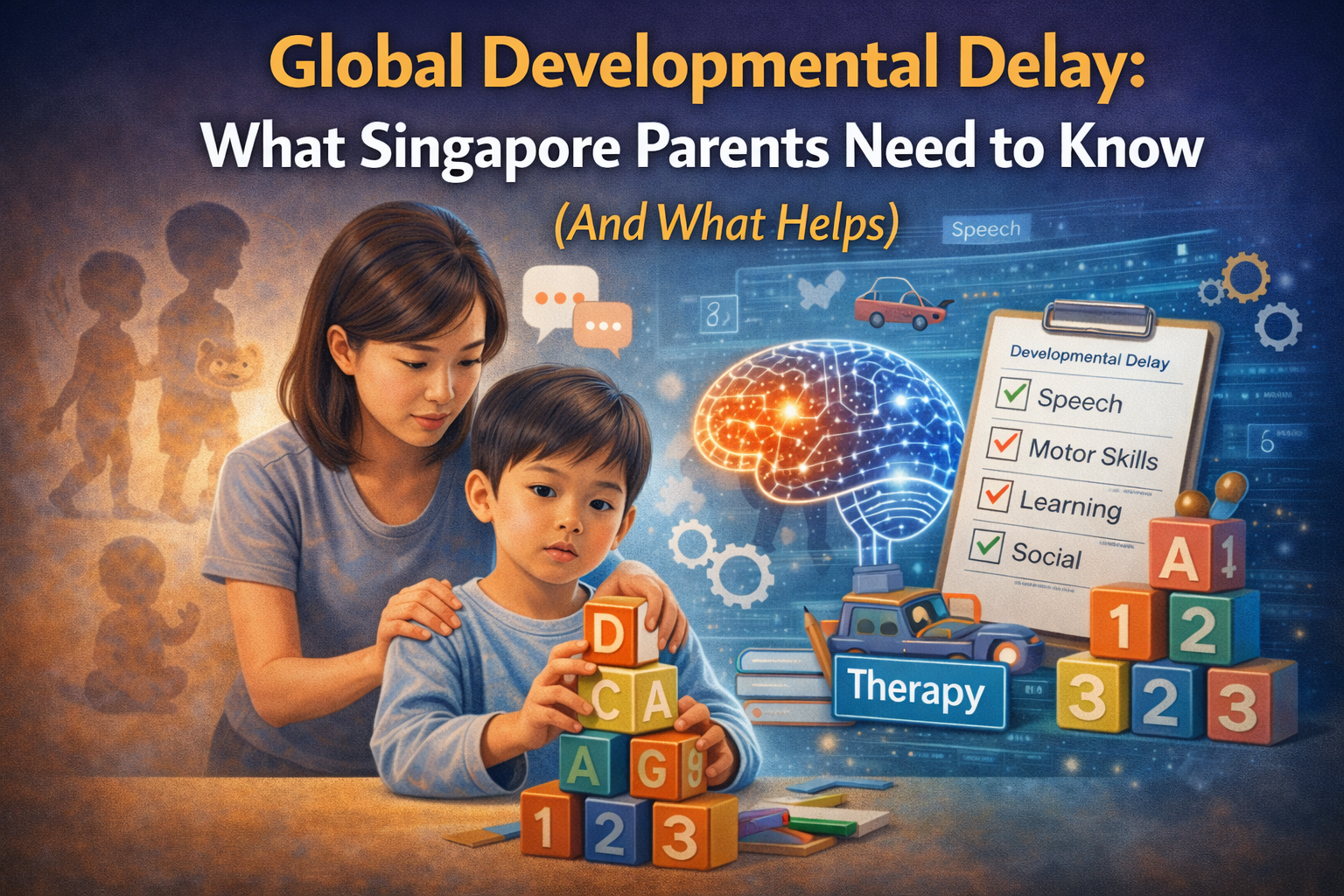
But when delays appear across multiple areas of development—such as speech, motor skills, learning, and social interaction—it may point to a condition known as Global Developmental Delay (GDD).
In Singapore, awareness of developmental conditions is increasing, and more parents are seeking early support. With timely intervention, structured therapy, and individualised learning support tailored to each child’s developmental pace, many children with GDD can make meaningful progress.
What Is Global Developmental Delay?
Global Developmental Delay (GDD) refers to a condition where a child shows significant delays in two or more developmental areas, including:
- Speech and language
- Gross motor skills (e.g. walking, jumping)
- Fine motor skills (e.g. writing, using utensils)
- Cognitive development (learning and thinking)
- Social and emotional skills
GDD is typically diagnosed in children under the age of five. As children grow older, the diagnosis may evolve into other conditions depending on their developmental trajectory.
It is important to understand that GDD is not a single disorder but a broad classification that helps identify children who need early intervention and support.
Early Signs Parents Should Look Out For
Many parents initially sense that something is “not quite right,” but are unsure whether it is serious.
Some common early signs include:
- Delayed speech or limited vocabulary
- Difficulty following simple instructions
- Poor coordination or clumsiness
- Trouble interacting with peers
- Slower learning compared to age group
Mrs Joanne Lee, a parent in Singapore, shared:
“My son was already three but could only say a few words. Other children his age were speaking in sentences. At first, we thought he was just a late talker.”
Similarly, Mr Kelvin Ong noticed differences in his daughter:
“She had trouble holding a pencil and didn’t seem interested in drawing or writing. Even basic tasks took much longer than expected.”
These early signs are often subtle but become more noticeable over time.
Why Early Diagnosis Matters
Early identification is one of the most important factors in improving outcomes for children with GDD.
When intervention begins early:
- Brain plasticity is higher
- Learning capacity is greater
- Progress tends to be faster
Without early support, delays can widen and affect:
- Academic readiness
- Social interaction
- Confidence
Mrs Siti Rahman shared:
“We waited too long because we thought she would catch up. Looking back, we wish we had acted earlier.”
Getting a Diagnosis in Singapore
If GDD is suspected, parents should seek a professional assessment. Singapore has several established pathways for diagnosis.
1. KK Women’s and Children’s Hospital (KKH) – Child Development Unit
Website: https://www.kkh.com.sg
KKH is one of the main public healthcare institutions providing developmental assessments.
Services include:
- Developmental screening
- Multidisciplinary assessment
- Therapy referrals
⭐ Google review:
“The doctors and therapists were very patient and thorough. We felt supported throughout the process.” — ★★★★★
2. National University Hospital (NUH) – Child Development Unit
Website: https://www.nuh.com.sg
NUH offers comprehensive developmental assessments and intervention planning.
⭐ Google review:
“Professional team and clear explanations. They helped us understand our child’s needs.” — ★★★★☆
3. Integrated Child Development Services (ICDS)
Website: https://www.icds.com.sg
ICDS provides early intervention and therapy services for children with developmental delays.
⭐ Google review:
“Structured programmes and caring therapists. We saw gradual improvement over time.” — ★★★★★
4. THK Development Support & Learning Support
Website: https://www.thkmc.org.sg
THK offers early intervention programmes for preschool-aged children.
⭐ Example Google review:
“Affordable and supportive environment. Teachers are experienced with special needs children.” — ★★★★★
5. Kaleidoscope Therapy Centre
Website: https://kaleidoscope.com.sg
A private centre offering multidisciplinary therapy services.
⭐ Example Google review:
“Very personalised approach. Therapists are dedicated and knowledgeable.” — ★★★★★
What Happens After Diagnosis?
After a diagnosis, parents usually work with professionals to create a structured plan.
This may include:
- Speech therapy
- Occupational therapy
- Early intervention programmes
- Educational support
Mrs Joanne Lee shared:
“The diagnosis was overwhelming at first, but it gave us direction. We finally knew what to do.”
Types of Therapy That Help
Children with GDD often benefit from a combination of therapies.
Speech Therapy
Focuses on:
- Language development
- Communication skills
- Understanding and expression
Occupational Therapy
Helps with:
- Fine motor skills
- Daily living skills
- Sensory processing
Early Intervention Programmes
Provide structured learning environments tailored to developmental needs.
The Role of Personalised Academic Support
As children grow older, academic demands increase. Some children with GDD may need additional help beyond therapy.
With individualised learning support tailored to each child’s developmental pace, tutors can:
- Reinforce basic concepts
- Adapt teaching methods
- Build confidence gradually
Parents often turn to personalised home tuition support via Tutor City (https://tutorcity.sg) to find tutors who:
- Understand developmental differences
- Provide patient, structured guidance
- Work alongside therapists
Case Studies:
Case 1: Late Start, Steady Progress
Mrs Joanne Lee
“We started intervention when he was almost four. Progress was slow initially, but after a year, he could communicate much better. The improvement gave us hope.”
Case 2: Early Intervention Advantage
Mr Kelvin Ong
“We acted early when she was two and a half. With therapy and support, she is now coping well in preschool and interacting more with other children.”
Case 3: Confidence and Independence
Mrs Siti Rahman
“Before intervention, she depended on us for everything. Now she can do simple tasks on her own. That independence means a lot.”
Supporting Your Child at Home
Parents play a key role in development.
Helpful strategies include:
- Consistent routines
- Simple instructions
- Positive reinforcement
- Encouraging communication
Small daily efforts can make a big difference over time. Families may also explore private therapists or SEN trained teachers for home visits to complement therapy with consistent one-to-one academic guidance. Check some of the profiles from https://tutorcity.sg/ which has a list of special needs teachers to choose from.
Therapy Centres in Singapore (With Reviews & Details)
Below are some well-known therapy centres in Singapore that support children with developmental delays. These include speech therapy, occupational therapy, and early intervention programmes.
1. KK Women’s and Children’s Hospital – Child Development Unit
Website: https://www.kkh.com.sg
📍 100 Bukit Timah Road, Singapore 229899
Description:
KKH is one of Singapore’s leading public hospitals offering multidisciplinary developmental assessments and intervention planning. It is often the first referral point for parents.
⭐ Google Review 1:
“Doctors and therapists were very patient and thorough. We felt supported every step of the way.”
⭐ Google Review 2:
“Long waiting time, but the quality of care and detailed assessment made it worth it.”
2. National University Hospital – Child Development Unit
Website: https://www.nuh.com.sg
📍 5 Lower Kent Ridge Road, Singapore 119074
Description:
NUH provides comprehensive developmental assessments and therapy referrals. Their team includes paediatricians, psychologists, and therapists.
⭐ Google Review 1:
“Professional team with clear explanations. Helped us understand our child’s condition better.”
⭐ Google Review 2:
“Well-structured process and caring staff. We felt reassured after the consultation.”
3. THK Development Support & Learning Support
Website: https://www.thkmc.org.sg
📍 Multiple centres across Singapore
Description:
THK offers early intervention programmes for preschool children with developmental delays, often at subsidised rates.
⭐ Google Review 1:
“Teachers are very experienced with special needs children. My child improved over time.”
⭐ Google Review 2:
“Affordable and supportive environment. Staff are patient and encouraging.”
4. Kaleidoscope Therapy Centre
Website: https://kaleidoscope.com.sg
📍 39 Jalan Pemimpin, #02-01, Singapore 577182
Description:
A private therapy centre offering speech therapy, occupational therapy, and educational support with a personalised approach.
⭐ Google Review 1:
“Therapists are very dedicated and knowledgeable. Sessions are well-structured.”
⭐ Google Review 2:
“We saw improvements in communication and behaviour after a few months.”
5. KidsFirst (Mount Alvernia)
Website: https://kidsfirst.com.sg
📍 820 Thomson Road, Singapore 574623
Description:
KidsFirst provides developmental assessments and therapy services in a child-friendly environment.
⭐ Google Review 1:
“Friendly therapists who really connect with children. My son enjoys his sessions.”
⭐ Google Review 2:
“Clear guidance for parents and structured therapy plans. Very helpful overall.”
6. The Speech Practice
Website: https://speechpractice.com.sg
📍 290 Orchard Road, #08-04, Singapore 238859
Description:
Specialises in speech therapy for children with communication challenges, including those with developmental delays.
⭐ Google Review 1:
“Therapists are patient and engaging. My child became more confident in speaking.”
⭐ Google Review 2:
“Professional and child-friendly approach. Sessions are effective and enjoyable.”
7. EtonHouse E-Bridge Early Intervention
Website: https://www.etonhouse.edu.sg
📍 Multiple locations
Description:
Offers inclusive early intervention programmes integrating therapy with structured learning environments.
⭐ Google Review 1:
“Supportive teachers and structured programme. Good progress in social skills.”
⭐ Google Review 2:
“Holistic approach to development. We like the balance of learning and therapy.”
How to Choose the Right Therapy Centre
Choosing the right centre depends on:
- Your child’s specific needs
- Budget and subsidies
- Waiting time
- Location convenience
Some parents start with public hospitals (KKH/NUH), while others opt for private centres for faster access.
What Happens After Therapy Starts?
Therapy is not a quick fix. Progress often:
- Starts slowly
- Builds over time
- Requires consistency
Many parents combine therapy with individualised learning support tailored to each child’s developmental pace to reinforce learning outside sessions.
Final Thoughts
Global Developmental Delay can feel overwhelming, but Singapore offers a strong ecosystem of support—from hospitals to therapy centres and personalised tutoring options.
With early intervention, structured support, and consistency, children can make meaningful progress and build confidence over time.
For parents, the key is to act early, stay consistent, and build a support system that works for your child.